


 Modern Slavery Statement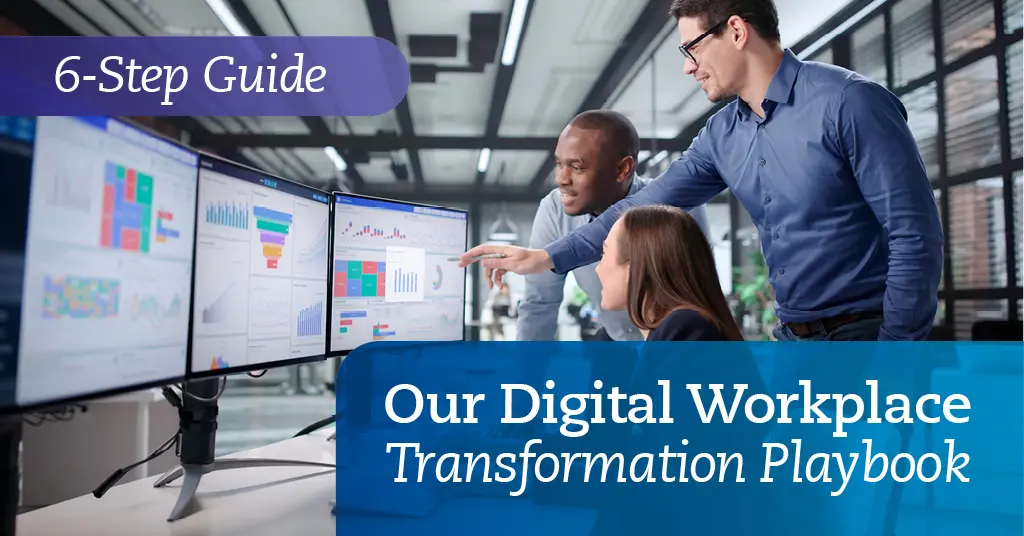
Our 6-Step Digital Workplace Transformation Playbook
If you walk into any UK workplace right now, you’ll probably find a mix of old and new technology. A handful of staff working from home via Teams, a printer queue that has been broken since Tuesday and an old finance system that doesn’t work with the booking system. None of this is really anyone’s fault. It’s just what happens when tech gets added in layers over the years rather than planned properly.
For procurement leads, office managers and IT decision-makers, sorting it out can feel like a huge task. That’s why we’ve put together our own playbook for digital workplace transformation, built from years of experience working across hundreds of organisations as one of the UK’s top workplace technology providers.
What is a digital workplace transformation?
Simply put, a digital workplace transformation is upgrading the technology and systems your employees use every day so they can work more securely and productively. It’s not always very visible, but your team will feel it through reliable hardware, software that adds real value, processes that just work and IT support without the wait.
This is different from digital transformation in the broader sense, which tends to focus on how a business operates externally, through new customer platforms, e-commerce or automated services. A digital workplace transformation is internally focused. It focuses on your people rather than your customers – although happier and better-equipped staff usually end up serving customers better too.
Why digital workplace transformation matters for businesses today
Digital transformations are needed because the modern workplace has changed.
For one, hybrid working is now just working. Most organisations have settled into some blend of office and home, and the tools that support this are no longer optional extras. Recent research found that 79% of employees have lost time to technical difficulties during hybrid meetings, with some losing ten minutes or more just getting a call started. Multiply that across a whole organisation and the cost in lost time adds up fast.
Then there are the increased security and compliance risks. According to the UK government’s Cyber Security Breaches Survey 2025, 43% of UK businesses reported experiencing a breach or attack in the past year, with phishing the most common route in. Older devices and unsupported software make these risks worse, especially now that Windows 10 is out of support.
On top of this, AI is now changing what “good work” looks like. According to McKinsey, 88% of employees now say their organisation uses AI in at least one part of the business, up from 78% the year before. In our experience, the organisations that get the most value from AI tools aren’t necessarily the ones spending the most. Instead, they’re the businesses that sorted out their underlying systems first.
For more insights on how the modern workplace has changed, check out our workplace technology statistics resource.
Our practical 6-step guide: The Banner Digital Workplace Transformation Playbook
We call this framework our Digital Workplace Transformation Playbook – built on the connected thinking that runs through everything we do here at Banner.
We see these six steps work time and again for organisations that want to modernise their technology. You don’t need to tackle all six at once, but skipping the early steps tends to cause problems later.
- Audit your current workplace technology and digital ways of working
- Define what success looks like for your workforce, not just your IT department
- Establish secure, future-proof digital infrastructure
- Choose (and procure) technology that supports how your team’s work
- Provide digital workplace training and change management support
- Measure, monitor and review your digital transformation
Keep reading for our full digital transformation guide:
Step 1: Audit your current workplace technology and digital ways of working
Before you change anything, you need to build a picture of what currently exists.
That means cataloguing your existing hardware, software licences, contracts and support agreements, and mapping which systems connect to which. Most organisations find gaps at this stage that no one had officially accounted for.

For example, when Worcestershire County Council wanted to overhaul its print setup, our first step was an on-site audit across its locations to understand real usage rather than what was on the asset register. That audit shaped everything that followed and the result was a leaner print fleet with costs cut by over 40% over five years. We find most organisations underestimate just how much shadow IT exists (tools and workarounds that teams have adopted informally because the official systems weren’t working for them). A good audit should surface these, not just the approved asset list.
It’s tempting to rush or skip this stage because someone is keen to get to the more exciting business of choosing new kit – but don’t. The audit is usually where the real savings and risks first surface.
Step 2. Define what success looks like for your workforce, not just your IT department
Once you understand what’s already in place, it’s time to talk to the people who use it.
This is about going beyond the asset register and finding out how your workforce experiences technology day to day. Ask different teams what slows them down, what they work around and what they wish were.
different. A finance manager’s frustrations will look very different to a site worker’s or a teacher’s. Some will want fewer logins, others will want devices that survive a building site. Remote teams might just want a video call that doesn’t drop out.
In this case, the pitfall is letting one department, usually IT, set the success criteria alone. Technology that is secure and easy to manage but unloved by the people using it tends to get worked around, which creates new risks of its own. We’ve seen plenty of projects judged as a technical success and a user failure at the same time. The two aren’t the same thing, and treating them as if they are is one of the more common mistakes we come across at Banner.
Step 3: Establish secure, future-proof digital infrastructure
This is core infrastructure that everything else will sit on: your operating systems, network security, cloud architecture and device management. Get these wrong and every tool you add on top will underperform or create risk. For most organisations right now, that starts with Windows 11. Windows 10 reached the end of its support life in October 2025, so any devices still running it are now a security and compliance risk rather than just an inconvenience.
This is also the stage to think about device lifecycle management, secure data removal for old equipment, and how new devices will be imaged and configured before they even reach staff. Treating a digital workplace transformation as a one-off refresh (rather than building in a regular replacement cycle from the start) is a mistake we see all the time.
Step 4: Choose (and procure) technology that supports how your team’s work
With a secure foundation in place, you can start choosing the tech solutions that will shape your employees’ working lives day to day. This means thinking across all categories: computing hardware like laptops and desktops, audio and visual equipment for meetings and collaboration, print solutions, mobile devices, accessories and any specialist tools your sector needs. Our experience is that a smaller number of products and systems, properly chosen and properly supported, beats a longer list of poorly integrated ones every time.
Once you’ve decided what you need, many organisations underestimate how long the procurement process can take. Sourcing technology compliantly, at the right price and from the right suppliers takes time if you’re doing it without support. At Banner, we give organisations access to over 400 technology brands and more than 6.5 million product lines through a single account manager, meaning you can source everything from laptops to headsets to managed print through one supplier. For public sector organisations, we are listed on multiple compliant frameworks including Government Commercial Agency and NHS Supply Chain, so you can procure quickly and without a lengthy tender.
Head over to the to discover our full workplace technology range. Or get in touch and our dedicated account managers can provide all the expert guidance, solutions and support you need.

Step 5: Provide digital workplace training and change management support
New technology only delivers value if people use it and use it well. Therefore, at Banner, we advise on budgeting for training from the very start of the project.
This is also where some genuinely exciting learning tools come in. As VR experts, we work with organisations across education, government and the private sector on virtual reality training, letting staff practise skills or scenarios in an immersive environment before doing them for real. For many sectors, this is proving far more effective than traditional classroom sessions.
Assuming that because something feels intuitive to confident users it will feel intuitive to everyone is an easy assumption to make, and a costly one. Build in extra time for colleagues who are less confident with new systems and identify a few enthusiastic early adopters in each team who can help others along.

Step 6: Measure, monitor and review your digital transformation
The final step is the one that is easiest to skip once the rollout is finished: measurement.
A digital workplace transformation isn’t a one-off project with a finish line. As technology and business needs continue to evolve, an ongoing approach is needed to keep your standards high.
To do this we advise that you set a few simple measures from the start. We recommend tracking the following:
- IT support ticket volumes and resolution times
- Device downtime and age of fleet
- Number of separate systems staff need to log into
- Software licence utilisation (are you paying for tools no one uses?)
- Employee satisfaction with technology, gathered through short regular surveys
- Total cost of ownership across your technology estate, including support and maintenance
These reviews are also where the returns on consolidation become visible. We recently helped a UK police authority consolidate office supplies, technology peripherals and cleaning products into a single compliant contract. The savings and efficiencies were clear once we were able to measure spend and delivery performance across all categories in one place.
Ultimately, treating the go-live date as the end point is the pitfall here. Build in a review at three and twelve months and use it to plan the next round of improvements – rather than waiting for something to break.
How Banner can deliver your digital workplace transformation
Putting a framework like this into practice will involve juggling a lot of moving parts, often alongside your day job. This is where we can help.
We supply products and services from over 400 technology brands and have supply chain access to more than 6.5 million technology lines. So whatever mix of hardware, software and services your plan needs, we can source it for you. We are also listed on multiple compliant procurement frameworks, including Government Commercial Agency, NHS Supply Chain and a range of education frameworks, so you can move forward without a lengthy tender process.
We also supply facilities products, workwear, office supplies, print and interiors. That means we can consolidate your wider workplace procurement alongside your technology, simplifying invoicing and supplier management at the same time. You can see how this has worked for other public and private sector organisations in our case studies.
If you’re at the early stages of planning your own digital workplace transformation, or simply want to talk through your options, get in touch with our technology team.

Newland House
Tuscany Park
Normanton
Wakefield
West Yorkshire
WF6 2TZ

0843 538 311 (UK)
1800 905 907 (ROI)
Store




Banner Group Limited. Registered in England and Wales: 05510758
Our registered office is: Newland House, Tuscany Park, Wakefield, WF6 2TZ